

A Critical Need
Unaffordable and undermaintained
In St. Louis County, the affordable housing shortage is a daily reality for thousands of families. The gap between household incomes and housing costs continues to widen, forcing many to choose between a safe place to live and basic essentials like food, healthcare, and transportation.
By the numbers
The latest 2026 data paints a clear picture of the challenges facing our region:
• Roughly 23,985 households in St. Louis County are cost-burdened, meaning they spend more than 30% of their income on housing.
• Among renter households, 53% are cost-burdened, and 25% are “severely” cost-burdened, spending more than 50% of their income on rent.
• There are 7,720 renter households with extremely low incomes, yet only 3,605 homes available that they can afford—meaning over half have no access to affordable housing.
• 59% of homes and 56% of rental units in St. Louis County were built before 1970.
Older properties often require expensive repairs, such as electrical, plumbing, or structural work, that are cost-prohibitive for both owners and landlords. In those older properties, according to the August 2018 Report of the Governor’s Task Force on Housing, “Conditions may have deteriorated to the extent that the health and safety of residents is compromised.” Many of our homes have replaced older homes that were damaged by fire or had become too costly to maintain and repair.
Why hard work isn’t enough
Even for residents working in essential regional industries—such as healthcare, retail, and food service—the current housing market is often out of reach. For example, while the annual income required to afford a median-priced apartment in our area is $40,520, many entry-level and high-demand roles, such as home health aides or food preparation workers, earn significantly less.
Documented demand
Local housing studies confirm these systemic challenges. A 2023 analysis for the city of Hibbing identified a demand for 185 single-family units through 2035, noting the difficulty of building new homes for under $275,000—a price point that does not align with many working households.
In Virginia, a 2023 assessment found demand for 30 new homes valued at $150,000–$200,000, yet these homes are often out of reach through conventional financing.
How we are bridging the gap
North St. Louis County Habitat for Humanity provides a pathway to stable, affordable homeownership. We utilize energy-efficient building practices, volunteer labor, and community partnerships to deliver homes that are functionally unattainable through the open market. Our commitment includes:
• Building or rehabilitating at least five homes per year since 2006
• Providing financial literacy training, home maintenance education, and “sweat equity” requirements that empower families to build long-term stability
• Contributing to the local tax base, with Habitat homeowners in our region paying approximately $83,000 in property taxes in 2025
Join us
When families have a decent place to live, children perform better in school, health outcomes improve, and neighborhoods thrive. Whether you are a donor, a volunteer, or a future partner, you are helping us build a world where everyone has a foundation for a better life.
2026 Habitat on the Hill
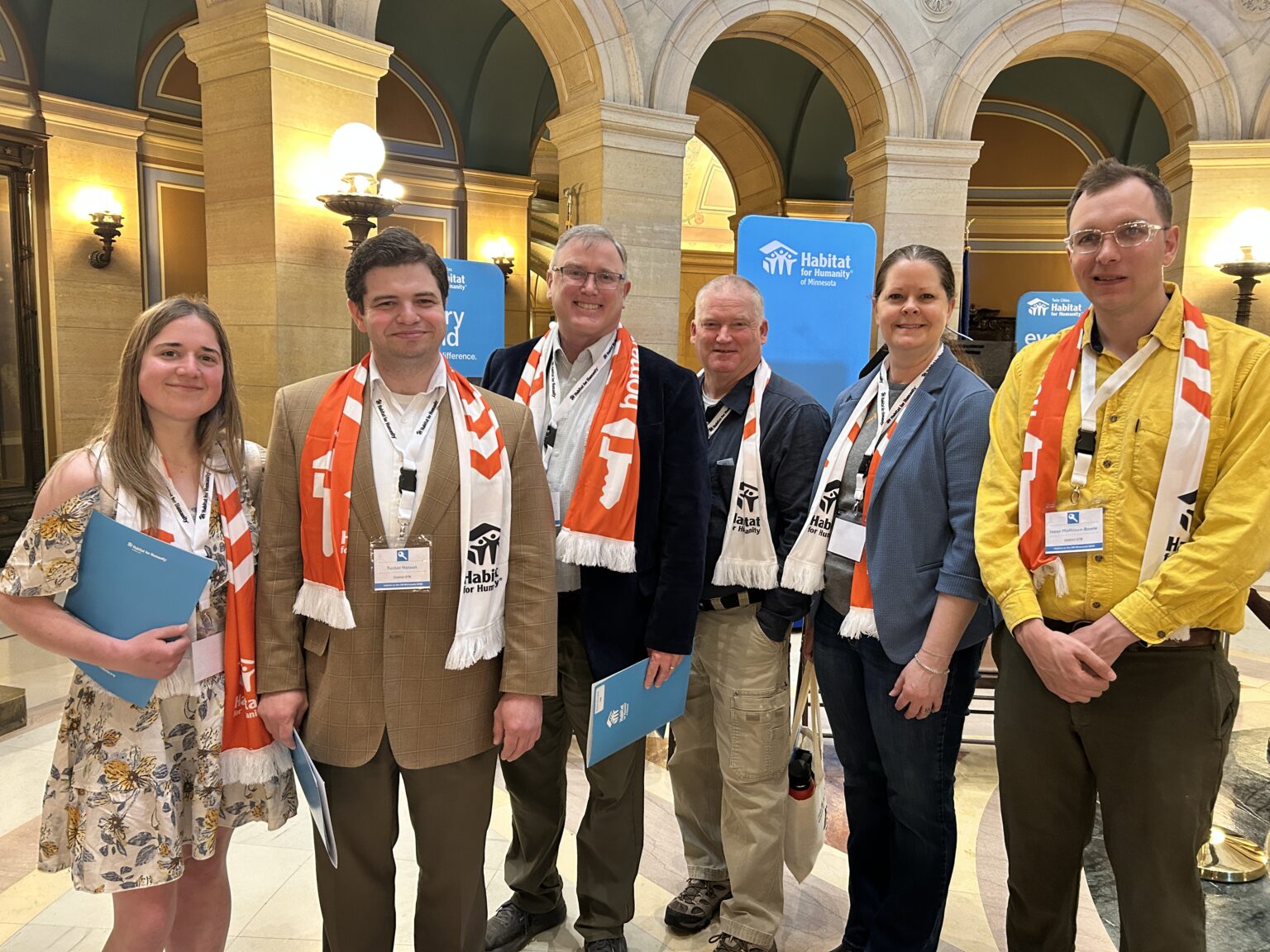
Habitat on the Hill is an annual nonpartisan advocacy event hosted by Habitat for Humanity of Minnesota and Twin Cities Habitat. On April 16, staff, board members, volunteers, and homeowners from across the state gathered at the Capitol in St. Paul to speak with elected officials and to support housing legislation.
NSLCHFH staff spoke with Rep. Spencer Igo, Rep. Cal Warwas, and Sen. Robert Farnsworth and explained how their votes could help make housing more accessible and affordable for more Minnesotans.
Maria High, an Eveleth homeowner, spoke in the Capitol rotunda! She said, “Every conversation you have, every relationship you build, every policy you help move forward adds up and builds an opportunity.

 PO Box 24